
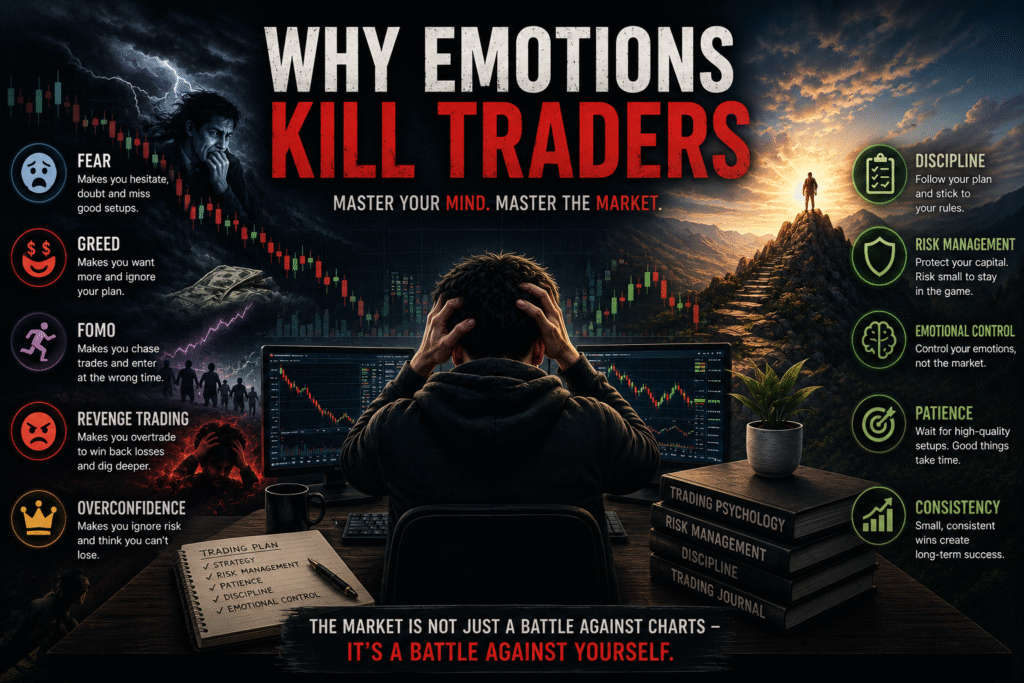
Most traders don’t lose because of bad strategies.
They lose because emotions take control at the worst possible moments.
Fear.
Greed.
FOMO.
Revenge trading.
Overconfidence.
These emotions quietly destroy discipline, consistency, and decision-making.
And in trading, emotional decisions are usually expensive.
🧠 Trading Is More Psychological Than Technical
Many beginners spend months searching for:
- the perfect indicator
- the best strategy
- secret entry signals
- high-win-rate systems
But experienced traders know something important:
A profitable strategy means nothing without emotional control.
Two traders can use the exact same strategy:
- one becomes profitable
- the other blows the account
The difference?
👉 Psychology.
😨 Fear Makes Traders Hesitate
Fear appears after losses or during market volatility.
Suddenly traders:
- skip valid setups
- close trades too early
- move stop losses
- avoid entering completely
Fear creates inconsistency.
And inconsistency destroys long-term results.
🔥 The Problem:
When traders fear losing money, they stop following the plan.
✅ The Solution:
Reduce position size and trust your system.
Smaller risk creates clearer thinking.
🤑 Greed Makes Traders Ignore Logic
Greed usually appears after winning trades.
A trader starts thinking:
“This trade can go even higher.”
Then:
- profits disappear
- take profits are ignored
- leverage increases
- risk management vanishes
Greed blinds traders to reality.
✅ Smart Traders:
- take profits systematically
- think long-term
- focus on consistency over excitement
🚀 FOMO Creates Terrible Entries
FOMO means:
Fear Of Missing Out.
A trader sees a huge candle moving fast and thinks:
“I need to enter NOW.”
Usually:
- the entry is late
- risk becomes terrible
- emotions replace analysis
And often the market reverses immediately after.
✅ Professional Traders Understand:
Missing one trade means nothing.
The market always creates new opportunities.
😡 Revenge Trading Destroys Accounts
This is one of the most dangerous emotions in trading.
After losing money, traders often try to:
“Win it back immediately.”
That leads to:
- emotional trades
- oversized positions
- overtrading
- impulsive decisions
Instead of recovering losses, traders usually create even bigger ones.
✅ What Professionals Do:
After emotional losses:
- they pause
- review mistakes
- reset mentally
- wait for high-quality setups
Patience protects capital.
😎 Overconfidence Is Also Dangerous
Winning streaks can be just as dangerous as losing streaks.
After several successful trades, traders often believe:
“I figured out the market.”
That’s when:
- discipline weakens
- leverage increases
- rules get ignored
The market punishes arrogance quickly.
✅ Smart Traders Stay Humble
They understand:
- losses are always possible
- risk management never stops
- discipline matters more than confidence
📊 Emotional Trading Usually Looks Like This
❌ Entering trades randomly
❌ Moving stop losses emotionally
❌ Closing winners too early
❌ Holding losers too long
❌ Trading out of boredom
❌ Overtrading after losses
❌ Ignoring the trading plan
These behaviors slowly destroy accounts.
🛡️ Discipline Is the Real Edge
Most successful traders are not emotional geniuses.
They simply follow rules consistently.
A strong trading system includes:
✅ entry rules
✅ stop loss rules
✅ take profit rules
✅ risk management
✅ emotional discipline
Without discipline, even the best strategy eventually fails.
📊 Better Analysis Helps Reduce Emotional Trading
Many emotional mistakes happen because traders enter the market without preparation.
Professional traders use tools like TradingView to:
✅ analyze setups
✅ plan trades
✅ track market structure
✅ improve discipline
✅ avoid impulsive decisions
The more prepared you are, the less emotional your trading becomes.
👉 Start improving your trading process with TradingView
🔥 Final Thoughts
Emotions are one of the biggest reasons traders fail.
The market constantly tests:
- patience
- discipline
- emotional control
- consistency
And mastering your emotions is often harder than learning technical analysis.
Because at the end of the day:
The market is not just a battle against charts — it’s a battle against yourself.