
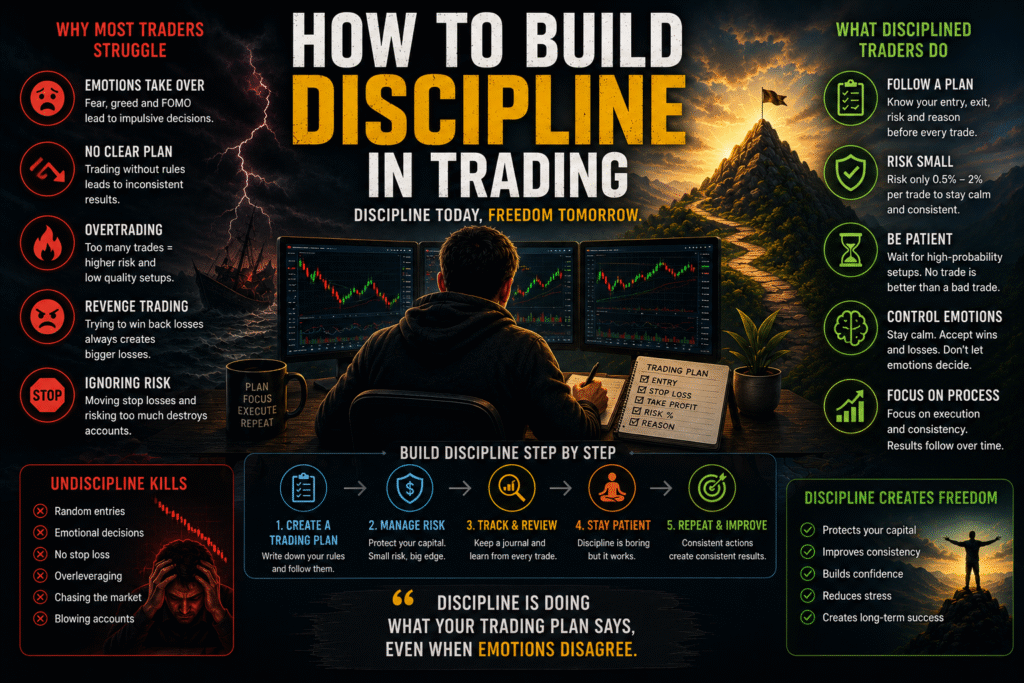
Discipline is one of the biggest differences between losing traders and consistently profitable traders.
Most traders already know:
- basic technical analysis
- chart patterns
- indicators
- trading strategies
But knowledge alone is not enough.
Without discipline:
- emotions take over
- rules get ignored
- risk increases
- consistency disappears
And eventually, accounts get destroyed.
📉 Why Most Traders Struggle With Discipline
The market constantly creates emotional pressure.
After losses:
😨 fear appears
After wins:
🤑 greed appears
During volatility:
🚀 FOMO appears
And emotions push traders into impulsive decisions.
Many traders:
❌ enter trades randomly
❌ overtrade
❌ revenge trade
❌ move stop losses
❌ ignore risk management
❌ chase the market
Discipline disappears when emotions control decisions.
🛡️ Discipline Means Following Rules
Professional traders understand something important:
Discipline is doing what your trading plan says — even when emotions disagree.
Discipline is:
✅ waiting for setups
✅ respecting stop losses
✅ taking planned profits
✅ controlling risk
✅ staying patient
✅ avoiding emotional trades
Trading without discipline becomes gambling.
📊 Create a Clear Trading Plan
Discipline becomes much easier when rules are clear.
Before every trade, you should know:
- entry point
- stop loss
- take profit
- risk percentage
- reason for entering
If you trade without a plan:
👉 emotions will make decisions for you.
💰 Risk Less to Think Clearly
One of the biggest reasons traders lose discipline is:
risking too much money.
When too much money is on the line:
- fear increases
- stress increases
- emotions become stronger
- logic disappears
✅ Smart Traders Usually Risk Small
Many professional traders risk:
- only 0.5%–2% per trade
Smaller risk helps traders stay calm and disciplined.
📓 Keep a Trading Journal
A trading journal helps you identify:
- emotional mistakes
- repeated bad habits
- impulsive behavior
- strengths and weaknesses
Track:
✅ entries
✅ exits
✅ emotions
✅ mistakes
✅ market conditions
Over time, patterns become obvious.
And awareness creates improvement.
⏳ Learn to Be Patient
Most bad trades happen because traders are impatient.
They:
- force setups
- trade from boredom
- chase candles
- enter too early
Professional traders know:
No trade is better than a bad trade.
Patience protects capital.
🚫 Stop Revenge Trading
After losses, emotional traders often try to:
“Win the money back immediately.”
This destroys discipline very quickly.
Revenge trading creates:
❌ emotional decisions
❌ oversized positions
❌ overtrading
❌ bigger losses
✅ What Disciplined Traders Do
After emotional losses:
- they pause
- review mistakes
- reset mentally
- wait for proper setups
🧘 Focus on Process, Not Money
Traders who constantly think about money become emotional faster.
Disciplined traders focus on:
- execution
- consistency
- probabilities
- following the system
Because long-term profits come from:
good habits repeated consistently.
📊 Better Preparation Creates Better Discipline
Preparation reduces emotional decision-making.
That’s why many traders use platforms like TradingView to:
✅ analyze charts
✅ plan setups
✅ track market structure
✅ create routines
✅ improve consistency
The more prepared you are, the easier discipline becomes.
👉 Improve your trading routine with TradingView
🔥 Final Thoughts
Discipline is not something traders are born with.
It is built through:
- repetition
- patience
- emotional control
- consistency
- self-awareness
The market rewards disciplined traders over emotional traders in the long run.
Because in trading:
Consistency beats intensity every time.