
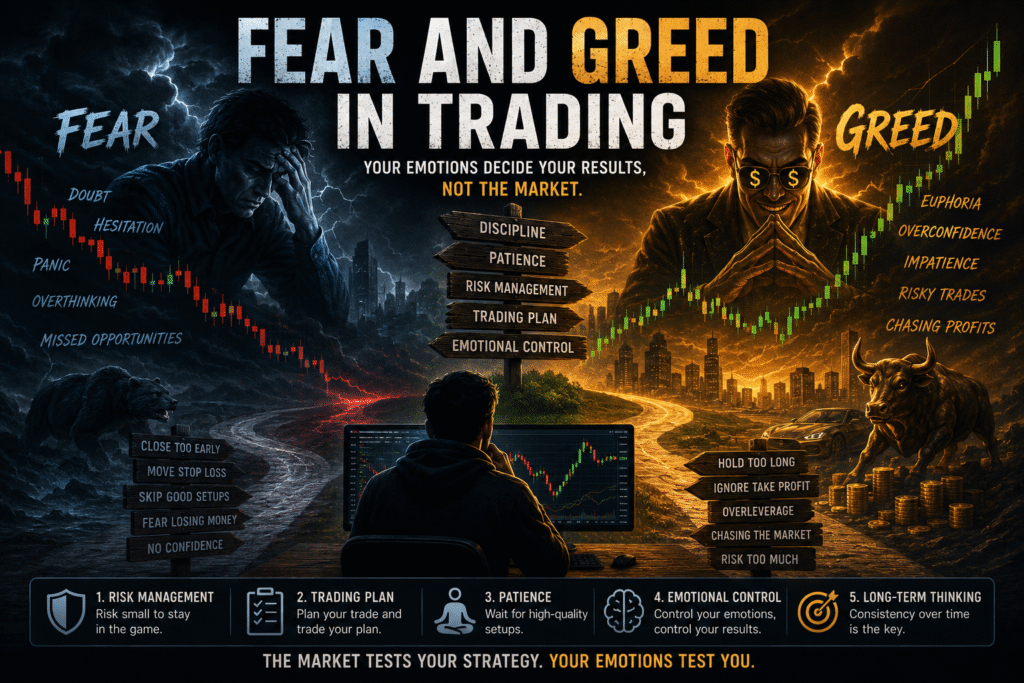
Fear and greed are the two strongest emotions in financial markets.
They control:
- decisions
- risk-taking
- patience
- discipline
- consistency
And most traders don’t even realize how much these emotions affect their trading.
The market moves with psychology.
That’s why understanding fear and greed is essential for long-term success.
😨 How Fear Affects Traders
Fear usually appears:
- after losses
- during volatility
- when risking too much money
- after emotional mistakes
Fear makes traders:
❌ hesitate
❌ skip valid setups
❌ close trades too early
❌ avoid opportunities
❌ panic sell
Many traders exit winning trades too soon simply because they are afraid of losing unrealized profits.
🔥 The Real Problem
Fear destroys confidence and consistency.
A trader starts doubting:
- the strategy
- the setup
- the analysis
- themselves
And once confidence disappears, emotional trading begins.
🤑 How Greed Destroys Traders
Greed appears when traders become obsessed with making more money.
It often happens:
- after winning streaks
- during strong market pumps
- when traders use high leverage
- during bull markets
Greed makes traders:
❌ ignore take profits
❌ overtrade
❌ risk too much
❌ chase candles
❌ hold positions too long
Greedy traders often turn winning trades into losing ones.
⚠️ The Dangerous Illusion
Greed creates the feeling that:
“This move will continue forever.”
But markets eventually reverse.
Always.
📉 Fear and Greed Create Market Cycles
The market itself is driven by mass psychology.
During Fear:
- traders panic
- selling increases
- volatility rises
- people expect crashes
During Greed:
- traders become euphoric
- risk-taking explodes
- everyone buys aggressively
- unrealistic expectations appear
This emotional cycle repeats constantly in:
- crypto
- stocks
- forex
- commodities
The market changes.
Human psychology doesn’t.
🚀 FOMO Is Fear and Greed Combined
FOMO (Fear Of Missing Out) is one of the most dangerous emotional states.
A trader sees price exploding upward and thinks:
“I’m missing the opportunity.”
This creates:
- emotional buying
- late entries
- bad risk-to-reward trades
- impulsive decisions
Usually near local tops.
✅ Smart Traders Understand:
You do not need every trade.
Patience is more profitable than emotional chasing.
😡 Revenge Trading Comes From Emotional Pain
After losing money, traders often feel:
- frustration
- anger
- desperation
And then they try to:
“Win it back fast.”
This leads to:
❌ overtrading
❌ gambling behavior
❌ oversized positions
❌ emotional entries
Revenge trading is driven by emotional pain — not logic.
🛡️ How Professional Traders Control Fear and Greed
Successful traders don’t eliminate emotions completely.
They learn to manage them.
✅ They Use Risk Management
Small risk reduces emotional pressure.
Many professionals risk:
- only 1% or less per trade
✅ They Follow a Trading Plan
Before entering a trade, they know:
- entry
- stop loss
- take profit
- risk
- trade reason
Planning removes emotional decision-making.
✅ They Stay Patient
Professional traders wait for:
- quality setups
- confirmations
- proper risk-to-reward opportunities
They don’t chase the market emotionally.
✅ They Think Long-Term
One trade means nothing.
Consistency over hundreds of trades matters far more.
📊 Better Preparation Reduces Emotional Trading
Fear and greed become stronger when traders enter the market unprepared.
That’s why many traders use tools like TradingView to:
✅ analyze market structure
✅ plan trades calmly
✅ track key levels
✅ improve discipline
✅ avoid emotional decisions
The more prepared you are, the less emotions control your trading.
👉 Improve your chart analysis with TradingView
🔥 Final Thoughts
Fear and greed are part of every market.
They influence:
- beginners
- experienced traders
- institutions
- entire market cycles
But traders who learn emotional discipline gain a massive advantage.
Because in trading:
The biggest battle is rarely against the market — it’s against your emotions.