
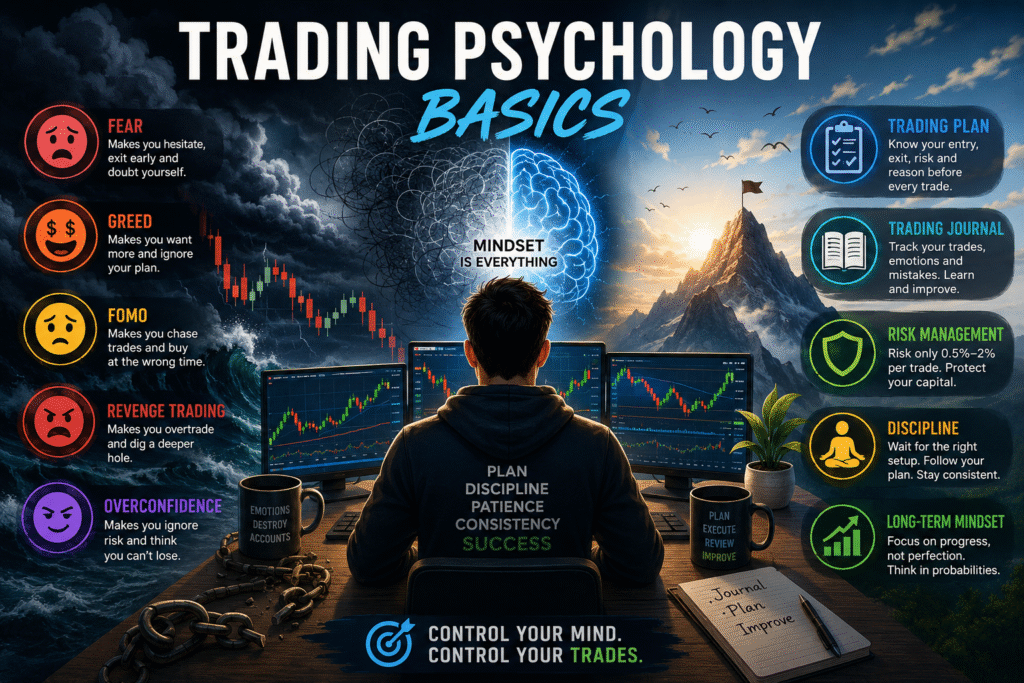
Most traders believe success comes from:
- the perfect strategy
- secret indicators
- expensive signals
- high leverage
But the truth is much simpler:
👉 Your biggest enemy in trading is usually your own psychology.
You can have the best strategy in the world, but if emotions control your decisions, consistency becomes impossible.
That’s why trading psychology is one of the most important skills every trader must develop.
📉 Why Trading Psychology Matters
The market constantly triggers emotions:
- fear
- greed
- stress
- excitement
- frustration
- overconfidence
And emotions lead to mistakes:
- closing winners too early
- holding losers too long
- revenge trading
- overtrading
- FOMO entries
Professional traders understand this:
Trading is less about predicting the market and more about controlling yourself.
😨 1. Fear
Fear appears when:
- you hesitate to enter trades
- you move stop losses
- you close trades too early
- you avoid setups completely
This usually happens because:
👉 you risk too much money per trade.
When your position size is too large, emotions become stronger than logic.
✅ Solution:
- lower your risk
- trust your system
- focus on probabilities, not individual trades
🤑 2. Greed
Greed makes traders:
- hold trades too long
- ignore take profit targets
- increase leverage recklessly
- chase unrealistic gains
The market often punishes greed very quickly.
✅ Solution:
- follow predefined targets
- secure profits systematically
- think long-term
Remember:
Consistent small wins beat emotional big wins.
🚀 3. FOMO (Fear Of Missing Out)
FOMO happens when traders think:
“Everyone is making money except me.”
This causes:
- late entries
- buying tops
- emotional trades
- impulsive decisions
✅ Solution:
- understand that opportunities never end
- wait for your setup
- avoid chasing candles
The market will always provide another trade.
😡 4. Revenge Trading
After a loss, many traders try to:
“Win the money back immediately.”
This creates:
- overtrading
- emotional entries
- huge losses
- account destruction
Revenge trading is one of the fastest ways to blow an account.
✅ Solution:
- take breaks after losses
- reduce emotional attachment to money
- accept losses as part of the game
Even professional traders lose trades daily.
😎 5. Overconfidence
After several winning trades, traders often feel:
“I can’t lose.”
This leads to:
- oversized positions
- ignoring risk management
- gambling behavior
And the market eventually humbles everyone.
✅ Solution:
- stay disciplined after wins
- keep risk consistent
- respect the market at all times
📊 The Importance of a Trading Plan
A trader without a plan is controlled by emotions.
Before every trade, you should know:
✅ Entry
✅ Stop Loss
✅ Take Profit
✅ Risk Percentage
✅ Trade Reason
If you enter randomly, emotions will take control.
📓 Keep a Trading Journal
One of the best habits for improvement.
Track:
- why you entered
- how you felt
- mistakes made
- emotional triggers
- trade results
Over time, you’ll notice repeating psychological patterns.
And awareness creates improvement.
🛡️ Risk Management Reduces Emotional Stress
Many successful traders risk only:
- 0.5%–2% per trade
Why?
Because smaller risk:
✅ reduces fear
✅ improves discipline
✅ protects capital
✅ helps consistency
Big risk creates emotional trading.
📊 Improve Your Trading Discipline With Better Chart Analysis
Many emotional trading mistakes happen because traders lack:
- structure
- preparation
- proper chart analysis
That’s why professional traders use platforms like TradingView to:
✅ plan trades
✅ analyze setups
✅ build trading routines
✅ stay disciplined
The better your preparation, the less emotional your trading becomes.
👉 Start analyzing charts with TradingView
🧘 Professional Trader Mindset
Professional traders:
- think in probabilities
- accept losses calmly
- focus on consistency
- protect capital first
- avoid emotional decisions
They understand:
Survival comes before profits.
🔥 Final Thoughts
Trading psychology is what separates gamblers from professional traders.
The market constantly tests:
- patience
- discipline
- emotional control
- consistency
And mastering yourself is often harder than mastering the charts.
Because in trading:
The biggest battle is usually happening inside your own mind.